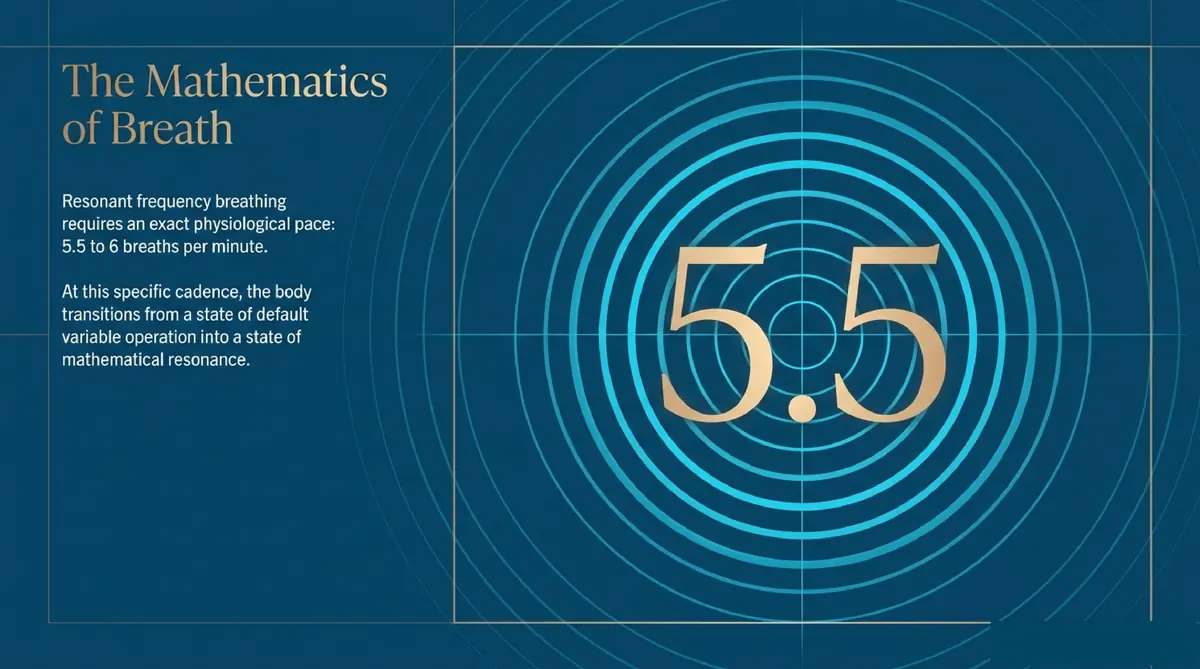
1. The Mathematics of Breath: 5.5 Breaths Per Minute
Resonant Frequency Breathing (also known as Coherent Breathing) requires an exact physiological pace: 5.5 to 6 breaths per minute. While default unconscious breathing fluctuates erratically between 12 and 20 breaths per minute, breathing at this precise mathematical cadence transitions the human body into a state of biological resonance.
At 5.5 breaths per minute, each complete respiratory cycle lasts exactly 11 seconds (5.5-second inhalation and 5.5-second exhalation). This specific frequency aligns cardiac and neurological systems into peak mathematical harmony.
2. Diagnostic Comparison of Physiological States
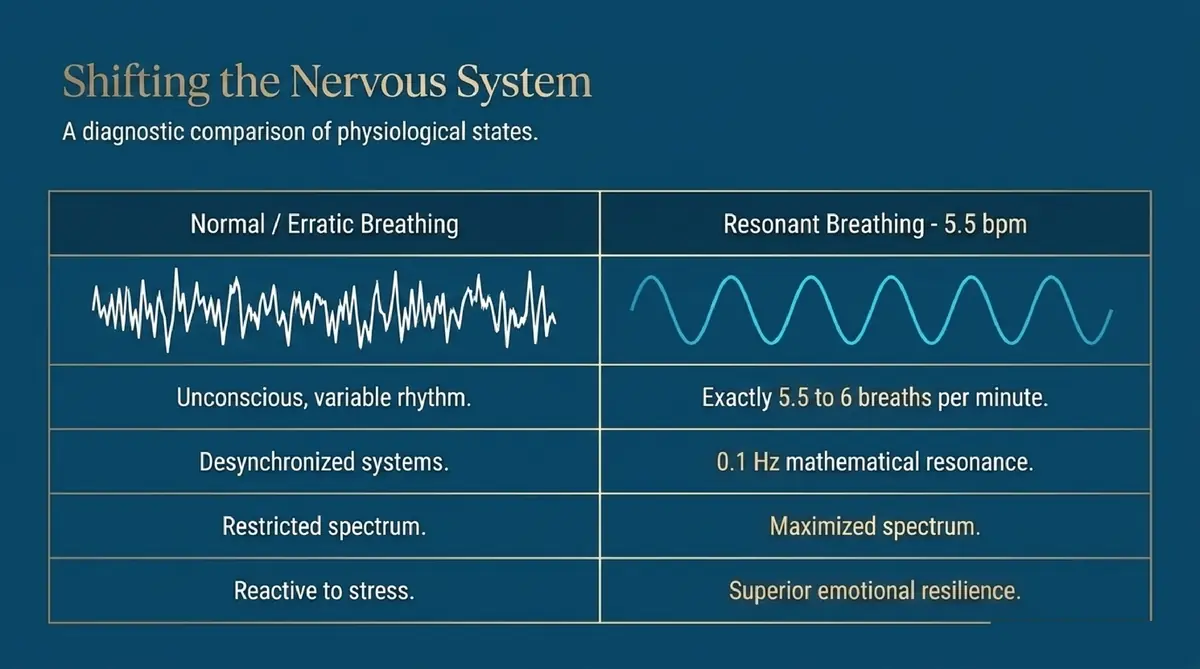
Clinical biofeedback monitoring demonstrates a stark contrast between default erratic breathing and 5.5 bpm Resonant Breathing:
| Diagnostic Marker | Normal / Erratic Breathing | Resonant Breathing (5.5 bpm) |
|---|---|---|
| Respiratory Rhythm | Unconscious, variable rhythm (12-20 bpm). | Exactly 5.5 to 6 breaths per minute. |
| System Alignment | Desynchronized physiological systems. | 0.1 Hz unified mathematical resonance. |
| HRV Spectrum | Restricted, low-amplitude HRV spectrum. | Maximized, high-amplitude HRV spectrum. |
| Stress Response | Highly reactive to environmental stress. | Superior emotional resilience and composure. |
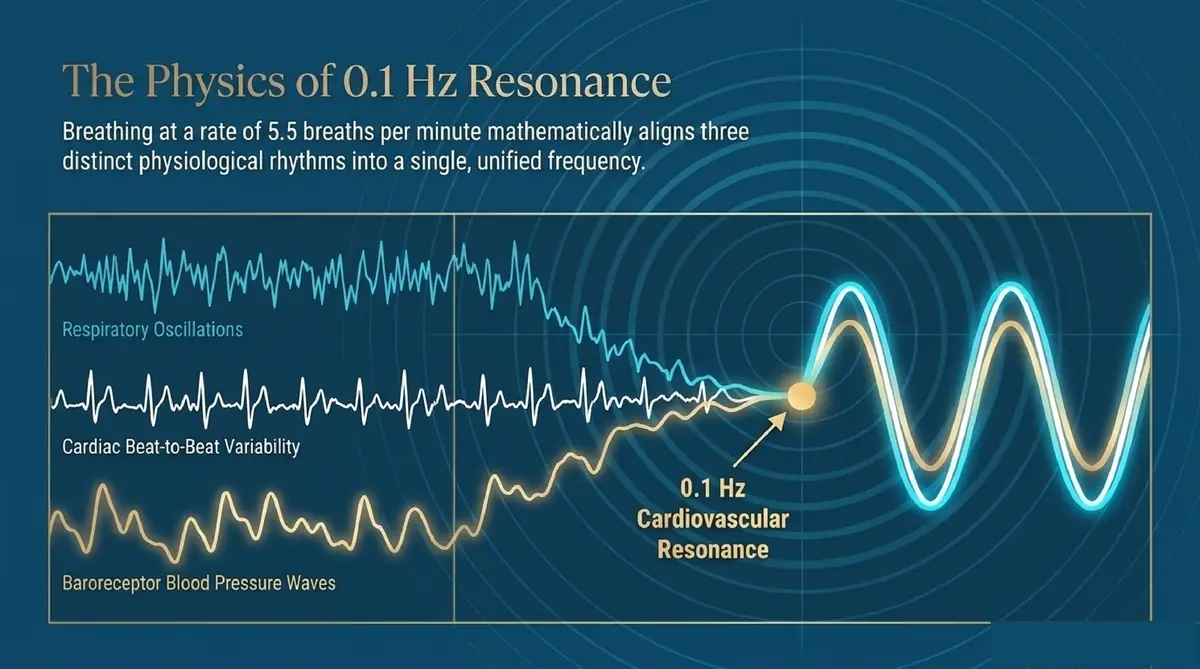
3. The Physics of 0.1 Hz Resonance
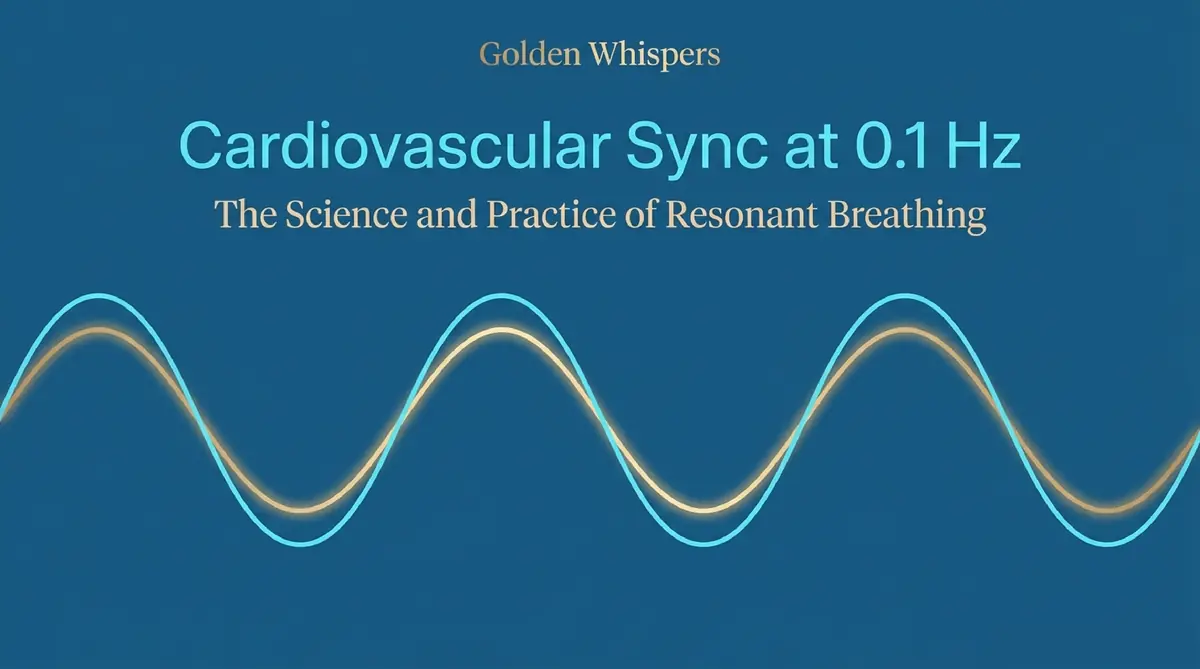
Breathing at a rate of 5.5 breaths per minute mathematically aligns three distinct autonomous biological rhythms into a single, unified frequency known as 0.1 Hz Cardiovascular Resonance:
The Three Synchronized Biological Rhythms
- Respiratory Oscillations: The rate of lung volume expansion and contraction.
- Cardiac Beat-to-Beat Variability: The instantaneous acceleration and deceleration of heart rate.
- Baroreceptor Blood Pressure Waves: Blood pressure oscillations governed by arterial stretch receptors.
When these three waves converge at 0.1 Hz (one full wave cycle every 10 to 11 seconds), constructive interference occurs, producing maximum physiological resonance across the entire cardiovascular tree.
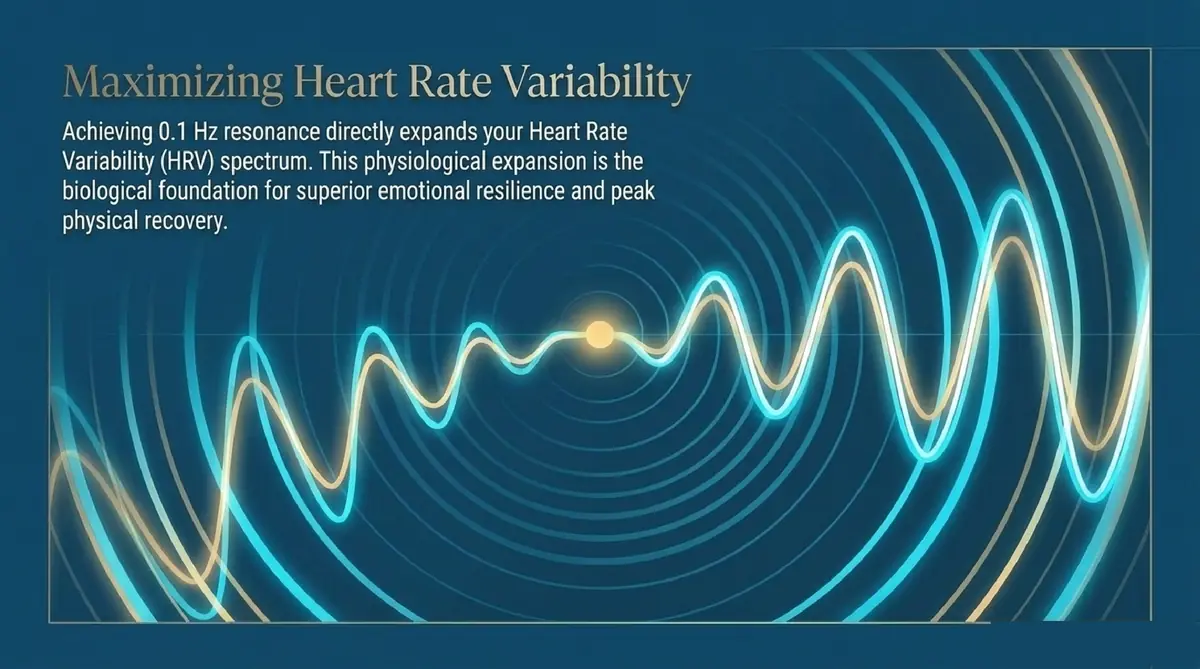
4. Maximizing Heart Rate Variability (HRV)
Achieving 0.1 Hz resonance directly expands your Heart Rate Variability (HRV) spectrum. Higher HRV correlates with greater vagal tone, enhanced autonomic adaptability, superior physical recovery, and profound emotional composure during acute stress.
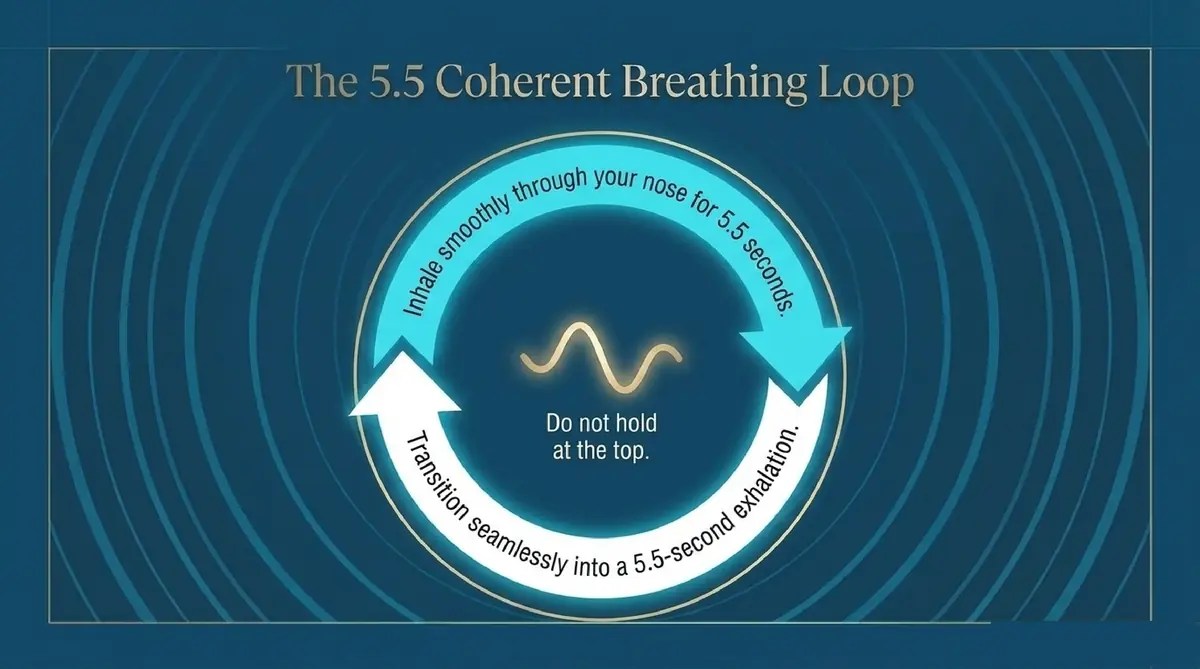
5. The 5.5 Coherent Breathing Loop Execution
To maintain smooth 0.1 Hz resonance, execute the continuous 5.5-second loop:
- Inhale (5.5 Seconds): Inhale smoothly through your nose for 5.5 seconds, filling your lungs from bottom to top.
- Zero Pause: Do not hold your breath at the top.
- Exhale (5.5 Seconds): Transition seamlessly into a smooth, unforced 5.5-second exhalation.
6. Manifestation & Biological Sync
Operating at 0.1 Hz cardiovascular resonance induces coherent alpha brainwave synchronization. Concluding your session with our daily manifestation affirmation—"I trust the timing of my life and breathe in gratitude for this moment"—anchors high-frequency emotional resilience directly into your subconscious mind.