Eating Properly Important considerations in eating and digesting food are:
1. Proper selection of food
2. Attractive appearance and aroma
3. Pleasant environment
Food should not be eaten under the stress of emotion. There should be only calmness and pleasantness at meal time; all adverse thoughts and emotions should be put aside. One should partake of food with a thankful, joyful heart.
Meat Eating versus Vegetarianism
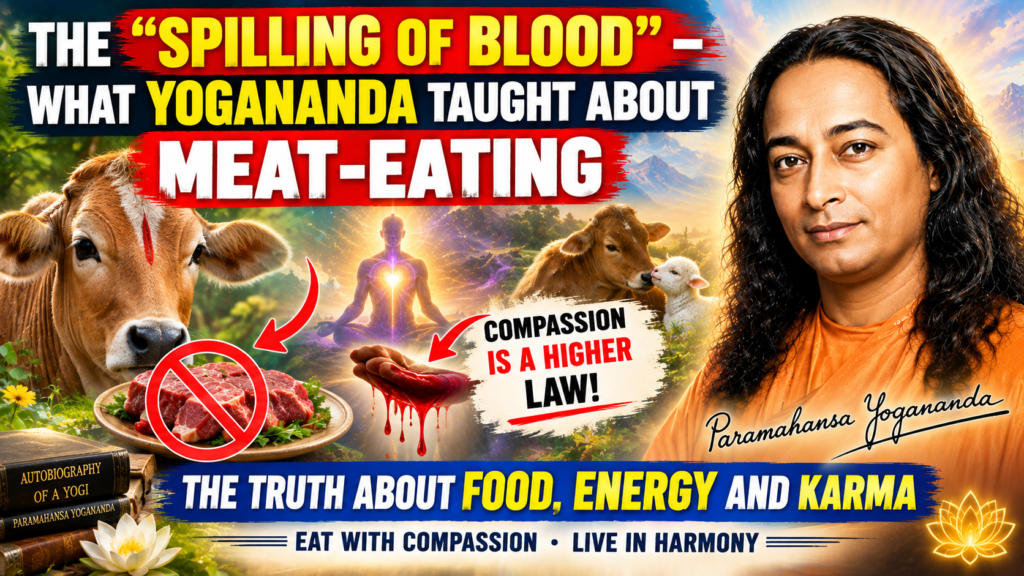
The question of meat eating and vegetarianism is a complicated and controversial subject. What I say will be governed by present world needs.I believe that no absolute view can be given which is good for all times and all people. Our conscience and human sensitiveness are roused much more by the killing of animals than by the slaughtering of vegetables and the skinning of fruits. Most steak eaters would not eat beef if they had to kill to get their meat, but no vegetarian would mind chopping off the heads of carrots. The spilling of blood and administering of pain in killing animals shows that the animals are approaching nearer to human beings in the scale of evolution. Meat is concentrated food and is strengthening, but it is highly constipating, a retainer of body poisons, and a harbinger of disease. Vegetables and fruits, having a natural laxative action, are conducive to health and to the elimination of diseases. Vegetables have to be eaten with more patience and are not as concentrated as meat; the improper eating of vegetables does not produce strength. Americans are suffering from obesity due to eating an overabundance of various forms of proteins, such as meat, milk, and nuts. Americans should become vegetarians. Meat-eating races are usually politically free. Vegetarian India has not been strong enough to dispel continuous foreign aggressions. Hindus have almost no protein to eat, and due to fanaticism they indulge in a starch-predominant diet, and therefore die thin and early in life. Animals live longer than human beings in India. As a temporary measure, present-day India needs to eat lamb, goat, and fowl until she can get enough milk or meat substitutes. Lamb has been found to agree better with the chemical elements in man’s body than any other form of meat. Man’s life is more valuable to all living creatures than is the life of animals. If the choice must be made whether man should eat meat in order to live, or whether the animals should live and man should die without eating meat, I would say that man should live at the expense of the animal. We find that both vegetarians and meat eaters have lived long and healthy lives. Jesus, Buddha, and St. Francis ate meat; Shankara, Chaitanya, and some great Christ-like saints of India did not eat meat. Saint Peter was shown a vision of some animals and asked to kill them and eat. “Thou shalt not kill” was meant to apply to people and not to animals. Moses and Jesus both ate meat, and Moses was the giver of the Ten Commandments. Fish have blood and a nervous system, but very few fish make any noise when they are killed. Life evolves more complex forms in the mammals, which have different tissues from the fish. The bull and hog, having highly developed, pugnacious nervous systems, feel greater pain and they loudly protest any attempt to kill them. These animals have evolved enough consciousness to understand the love of self-preservation and the injustice of inflicting pain, and therefore they should not be killed. The lamb protests less violently than the bull or hog. It looks as if the vegetables, fish, and meek animals are intentionally given by Nature a less developed nervous system that does not register much pain or evoke reactionary protests during pain. This may be one reason why these lower forms of life are made to sacrifice their lives for the maintenance of the higher forms of life.
💬 2 Thoughts on “The “Spilling of Blood” – What Yogananda Taught About Meat-Eating”